SMARTHISTORY
SMARTHISTORY
Participatory Strategy Workshop
Designing and facilitating a multi-day gathering to democratically set organizational goals and strategies
ROLE
Workshop designer
Facilitator
CLIENT
Smarthistory
TOOLS
Art of Hosting
Stakeholder mapping
Multi-causal mapping
OKRs
Overview
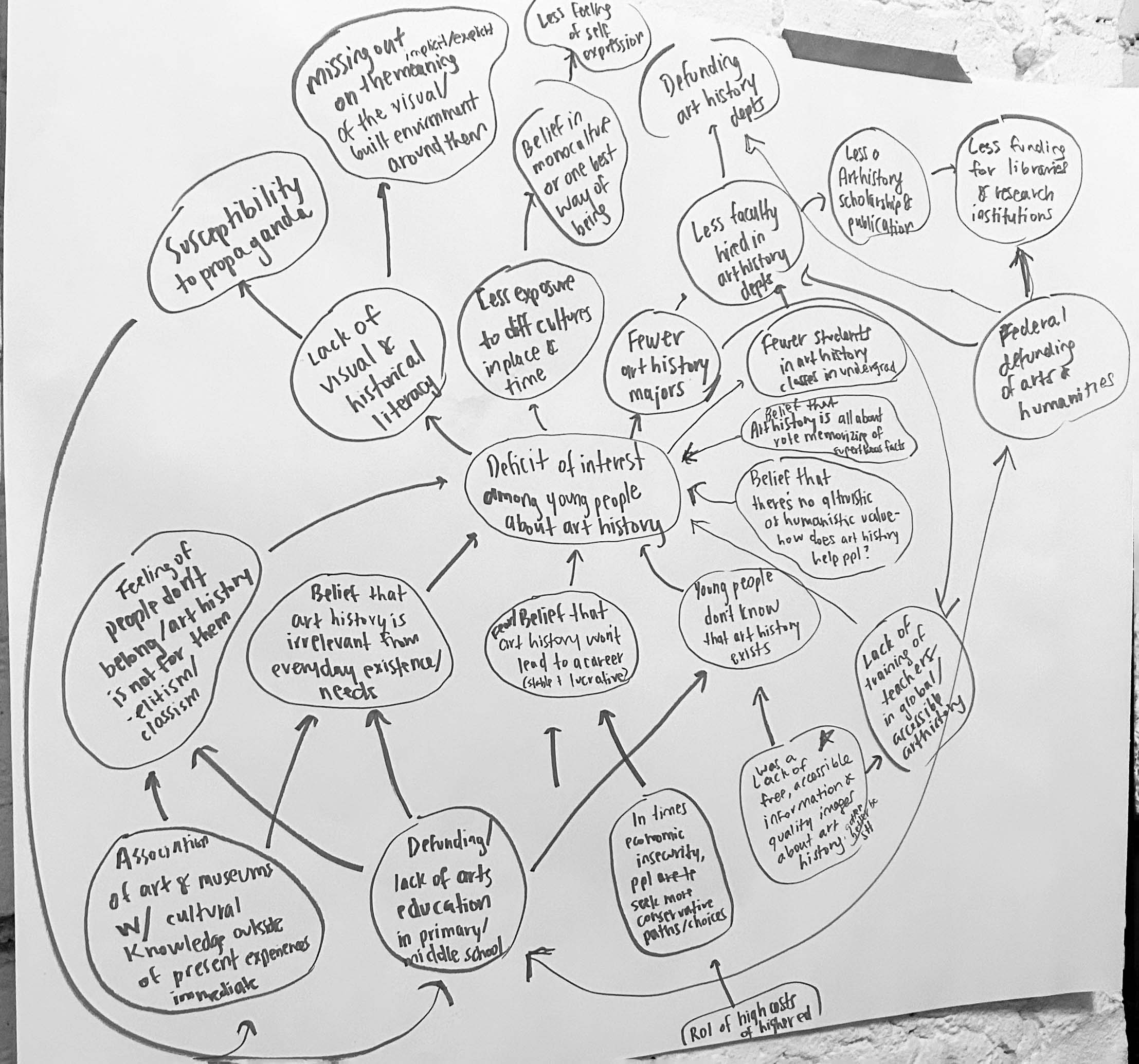
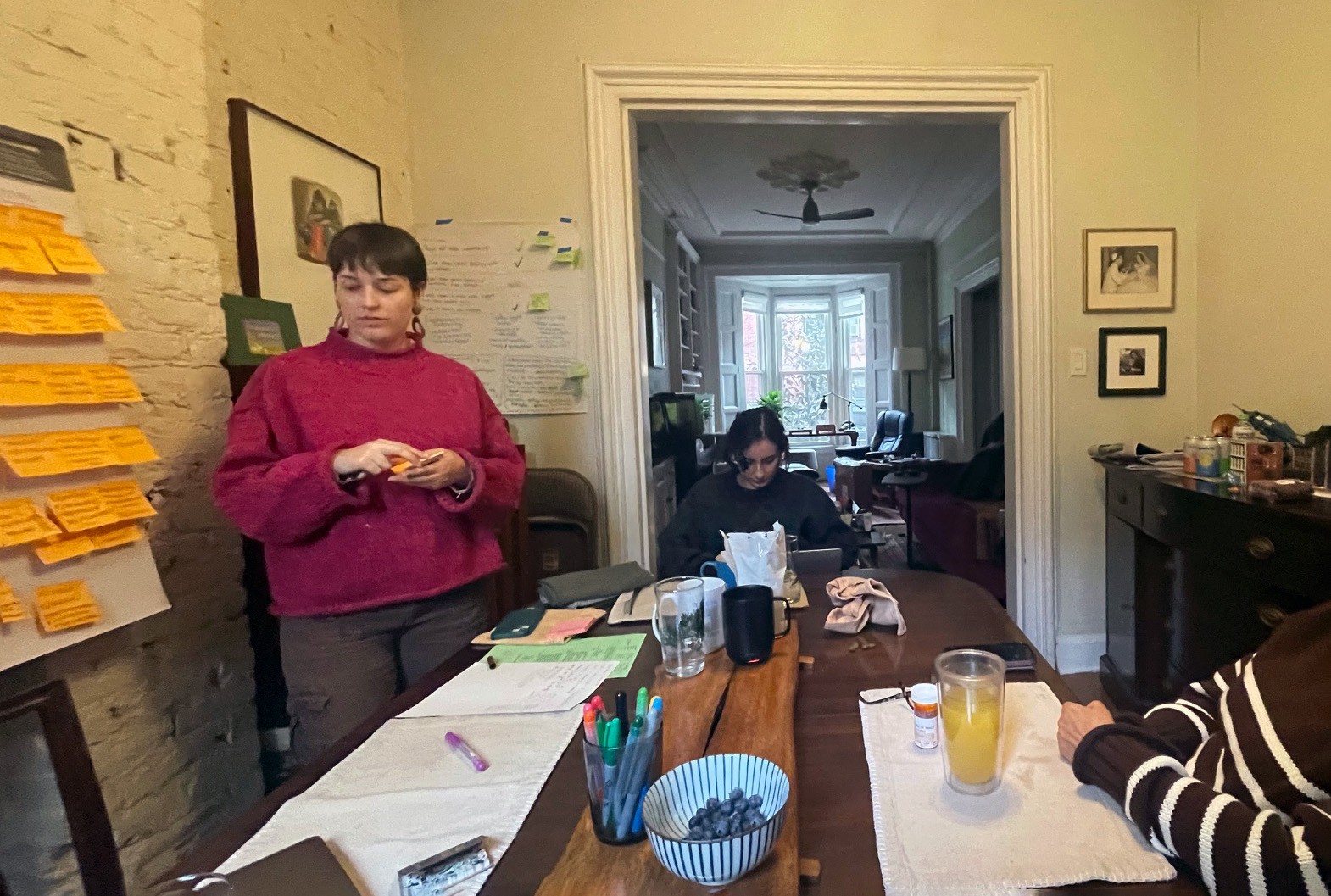
As a staff member at Smarthistory, a small art history open education nonprofit, I designed and facilitated two days of participatory workshopping to help the team reflect on the previous year and set goals, strategies, and priorities for the year ahead. Rather than coming in with a predetermined agenda, I built the two days around questions the team itself surfaced, leading to conversations about AI, higher education, and open education; the organization's core whys; and the fault lines and vulnerabilities of the broader discipline.
Overview
As a staff member at Smarthistory, a small art history open education nonprofit, I designed and facilitated two days of participatory workshopping to help the team reflect on the previous year and set goals, strategies, and priorities for the year ahead. Rather than coming in with a predetermined agenda, I built the two days around questions the team itself surfaced, leading to conversations about AI, higher education, and open education; the organization's core whys; and the fault lines and vulnerabilities of the broader discipline.
Context
Small nonprofits run lean. Capacity is always the real constraint, and the gap between what an organization wants to do and what it can actually sustain tends to quietly shape everything. One of the things I wanted this process to do was make that gap visible and shared — so that goal-setting could happen with a realistic picture of what we were working with, as well as room for the long-term visions at the heart of the organization.
Context
Small nonprofits run lean. Capacity is always the real constraint, and the gap between what an organization wants to do and what it can actually sustain tends to quietly shape everything. One of the things I wanted this process to do was make that gap visible and shared — so that goal-setting could happen with a realistic picture of what we were working with, as well as room for the long-term visions at the heart of the organization.
Participatory agenda setting
Participatory agenda setting
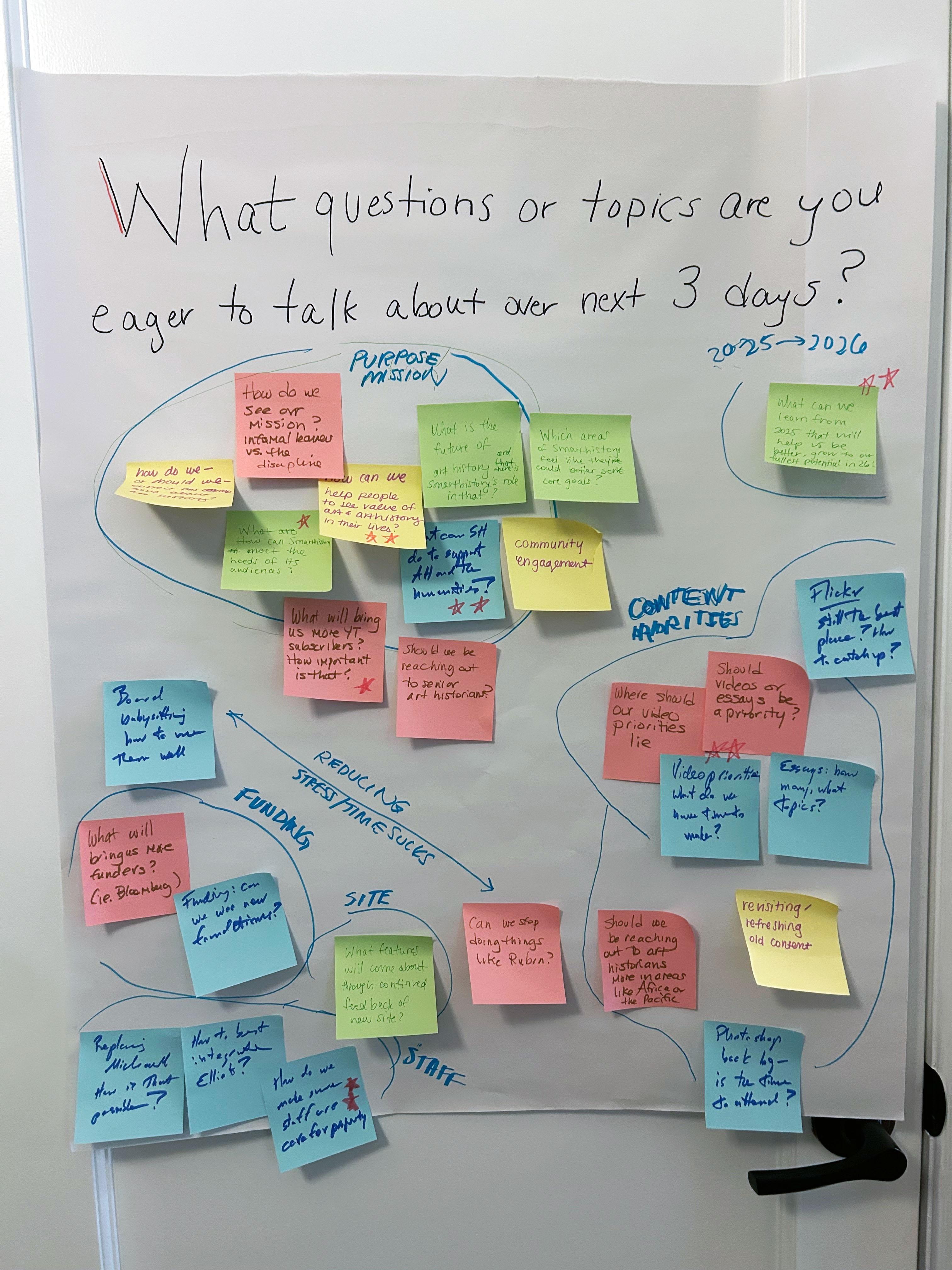
Before we could plan for the next year, I wanted to make sure we were focusing on the right things. I opened by inviting everyone, executive directors and staff, to surface the questions they most wanted to spend time on over the two days. Each person got three votes to prioritize. This shaped the agenda from the inside out rather than from the top down, and meant that when we got into hard conversations, people had chosen to be there.
Discovery
Define
Ideate
Prototype & Test
Design
Implement
Reflecting on the previous year
We started by going back before going forward. We reviewed the previous year's strategic goals together — celebrating what went well and naming what we could learn from and carry into the next year. This wasn't just a morale exercise. It grounded the planning in what had actually happened, rather than starting from scratch.
Reflecting on the previous year
We started by going back before going forward. We reviewed the previous year's strategic goals together — celebrating what went well and naming what we could learn from and carry into the next year. This wasn't just a morale exercise. It grounded the planning in what had actually happened, rather than starting from scratch.
Calculating our existing commitments
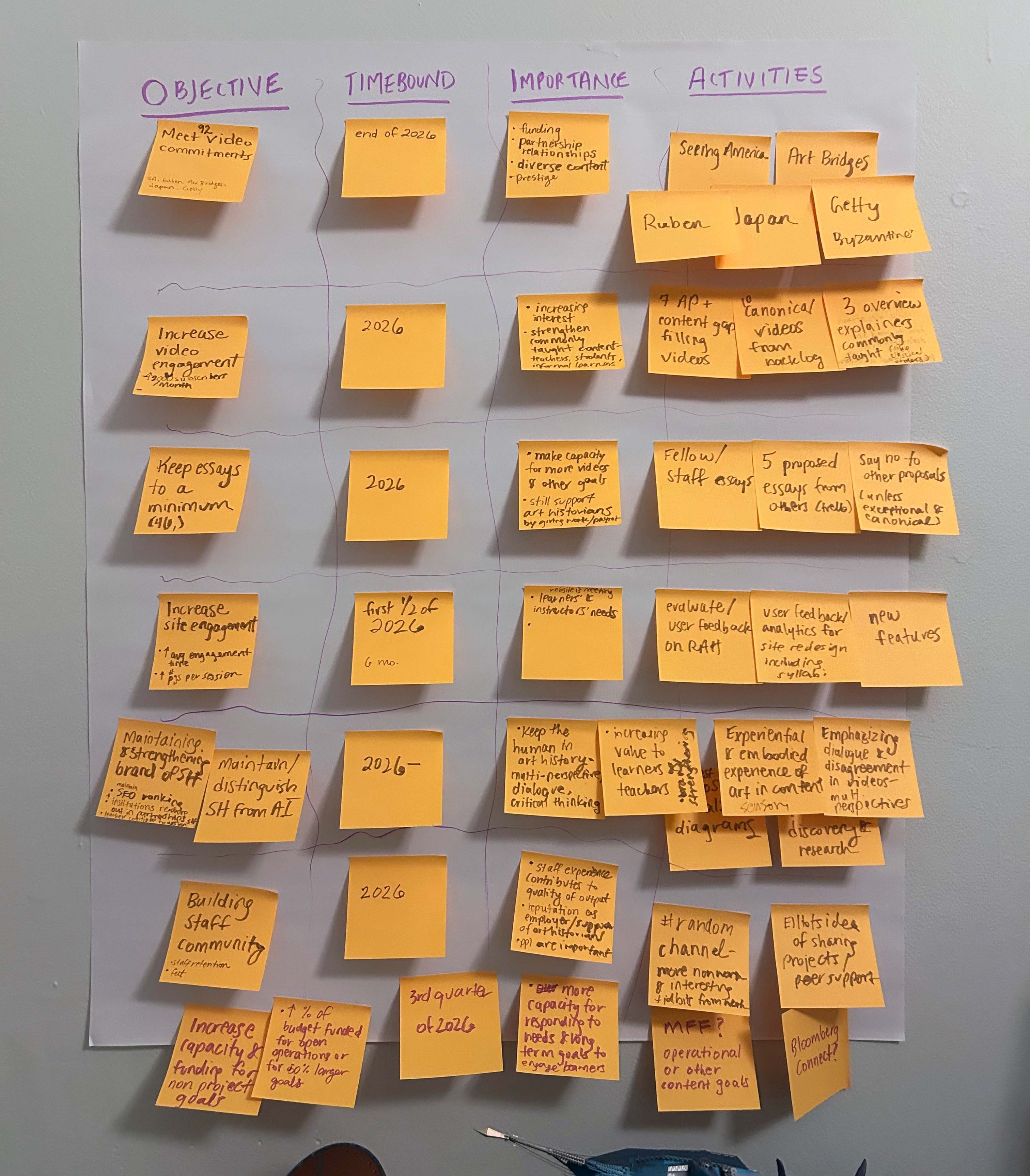
Before setting new goals, we mapped our existing commitments for the coming year — the funded projects, partnerships, and obligations already on the books. This gave us a shared, honest picture of our remaining capacity. It's easy to set ambitious goals in the abstract; it's harder, and more useful, to do it with real constraints on the table.
Calculating our existing commitments
Before setting new goals, we mapped our existing commitments for the coming year — the funded projects, partnerships, and obligations already on the books. This gave us a shared, honest picture of our remaining capacity. It's easy to set ambitious goals in the abstract; it's harder, and more useful, to do it with real constraints on the table.
OKR framework for strategic goal-setting
With that foundation, we used the OKR framework to identify strategic objectives across content strategy, operations, design and development, fundraising, and other areas. One of the more honest tensions that surfaced was between opportunistic activities — the funded projects and partnerships that come with predetermined deliverables and absorb capacity — and strategic priorities that aren't funded, like website maintenance or supporting the discipline at large. Naming that tension explicitly didn't resolve it, but it meant we could make more conscious decisions about it rather than just living inside it.
OKR framework for strategic goal-setting
With that foundation, we used the OKR framework to identify strategic objectives across content strategy, operations, design and development, fundraising, and other areas. One of the more honest tensions that surfaced was between opportunistic activities — the funded projects and partnerships that come with predetermined deliverables and absorb capacity — and strategic priorities that aren't funded, like website maintenance or supporting the discipline at large. Naming that tension explicitly didn't resolve it, but it meant we could make more conscious decisions about it rather than just living inside it.
5 Whys and Multi-causal Mapping: getting to the core
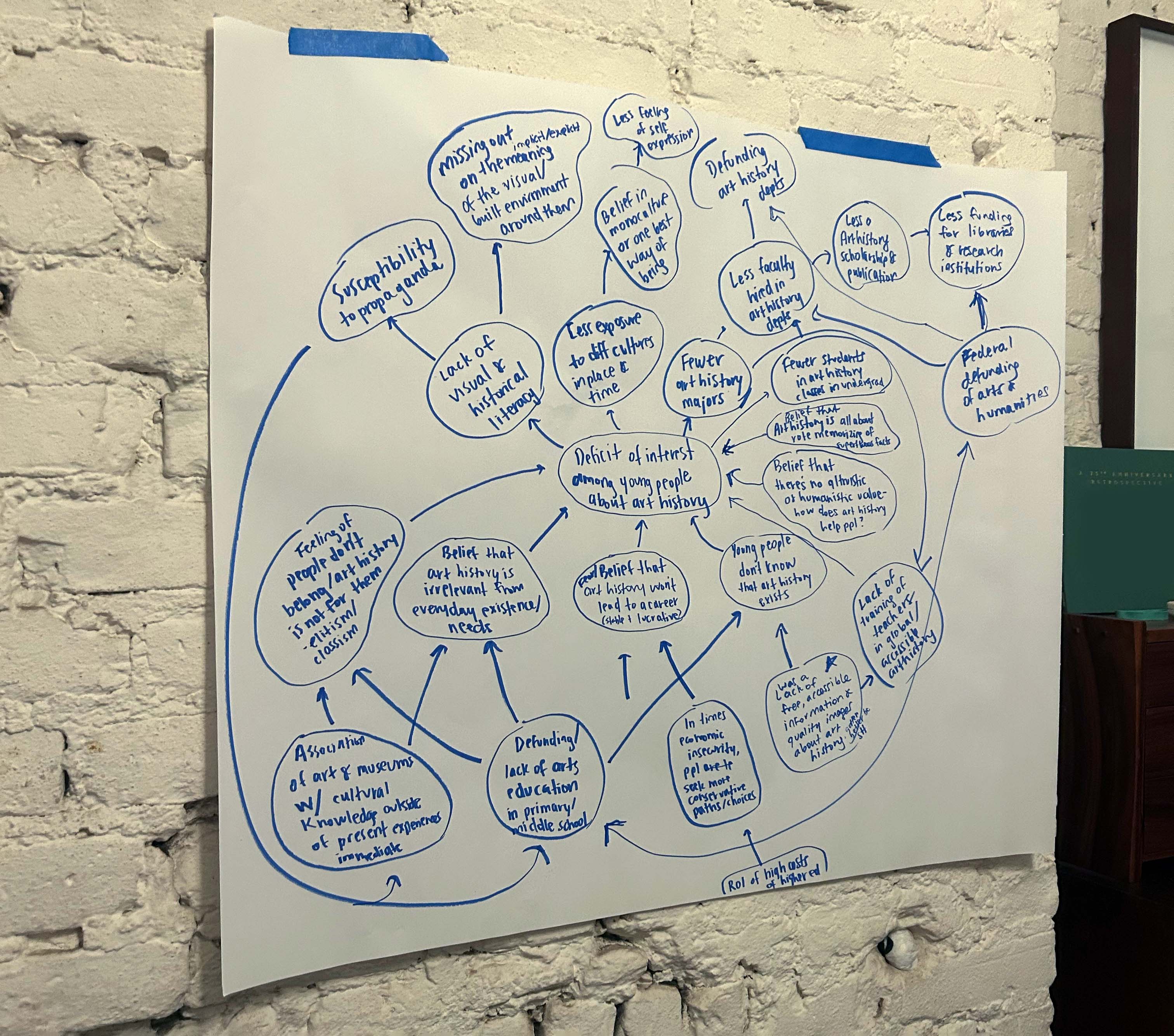
We did a 5 Whys activity to surface the organization's core why. This led somewhere more interesting than expected. If [Org Name]'s core goal is increasing interest in art history among young people, that goal rests on an assumption: that there's a deficit in interest to begin with. Following that thread led us to a harder question — why is there a deficit in interest and investment in learning art history among young people? — and to the beginning of a multi-causal map around it. We didn't answer it in the room, but naming it changed what felt strategic.
5 Whys and Multi-causal Mapping: getting to the core
We did a 5 Whys activity to surface the organization's core why. This led somewhere more interesting than expected. If [Org Name]'s core goal is increasing interest in art history among young people, that goal rests on an assumption: that there's a deficit in interest to begin with. Following that thread led us to a harder question — why is there a deficit in interest and investment in learning art history among young people? — and to the beginning of a multi-causal map around it. We didn't answer it in the room, but naming it changed what felt strategic.
Ecosystem mapping
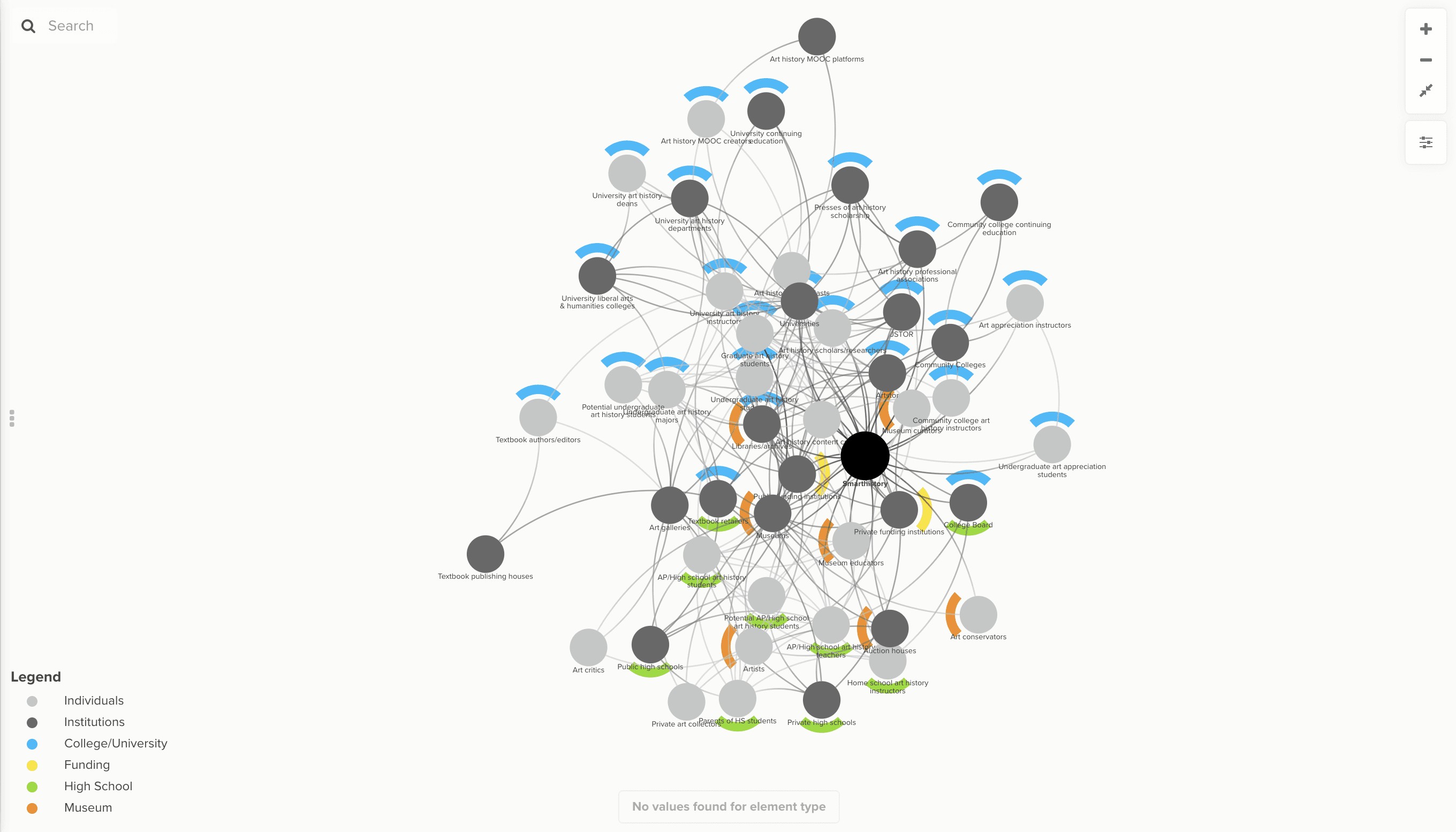
We collaboratively mapped the art history ecosystem — organizations, institutions, and groups of people (like art history undergrad majors, AP teachers, museum educators) who both influence and are influenced by the broader discipline. What emerged from this exercise was striking: [Org Name] is one of the most connected nodes in the ecosystem, reaching across museums, libraries, archives, universities, high schools, and more. That's not just a fact about our reach. It's a fact about our potential leverage — and our responsibility.
Ecosystem mapping
We collaboratively mapped the art history ecosystem — organizations, institutions, and groups of people (like art history undergrad majors, AP teachers, museum educators) who both influence and are influenced by the broader discipline. What emerged from this exercise was striking: [Org Name] is one of the most connected nodes in the ecosystem, reaching across museums, libraries, archives, universities, high schools, and more. That's not just a fact about our reach. It's a fact about our potential leverage — and our responsibility.
Outcomes
The team left the two days with a shared, realistic picture of our capacity and a set of strategic objectives we'd built together.
The OKR framework gave us common language for tracking progress and revisiting priorities
The 5 Whys and ecosystem mapping exercises surfaced questions that extended well beyond annual planning — about the organization's role in the discipline, and what it might mean to actively support art history at a moment when the field is under pressure
Executive leadership and staff shared feedback that the workshop design and process was night and day with previous strategy sessions, providing clarity and a collaborative approach to clearly externalizing and organizing a team-wide plan
The planning workshops have led to a desk research report on the health of the art history ecosystem by gathering data, press releases, and news reports to validate anecdotes which have been suggesting the discipline is under stess from funding cuts, layoffs, and department closures. This opened a strategic conversation about how Smarthistory could act on its position in the ecosystem in deliberate ways.
From 40% of benchmark tree test participants failing common navigation tasks
to
87.7% of AP and college instructors rated overall experience excellent or good
90% rated experience of moving around the site as very easy or easy
87% rated finding what they were looking for as very easy or easy
Staff have also shared feedback on the ease and intuitiveness of the admin interface now that fields and posts are consolidated and organized.
What I learned
Having led loosely organized strategy sessions before for my team, I was struck by how much more effective (and enjoyable) participatory, visual processes were for me and my team. These workshops were a direct product and application of several courses I had just taken in systems thinking and mapping, codesigning with care, and facilitating democratic participation—and it was incredible to see it pay off.
Next: Service Design & Information Architecture >
Next >
< Previous: Community Engagement
Next >
< Previous: Community-Centered Research
< Previous
© 2025 Kayla’s Portfolio. All Rights Reserved.